
A Fight Worth Preparing For

A wall shouldn’t win the night for you. It should give you time to notice the thing coming down the other road.
That’s the connection we’re trying to build between Vatra’s daytime work and its combat. You leave home for supplies, choose what to restore, and defend people whose lives change when you return. If the fighting is only repeated clicking, those choices have nowhere interesting to lead.
This is a design and development snapshot from October 12, 2026. Some of the revised behavior is implemented in an opt-in local candidate; integration, tuning and human playtesting are still in progress. It isn’t a release announcement.
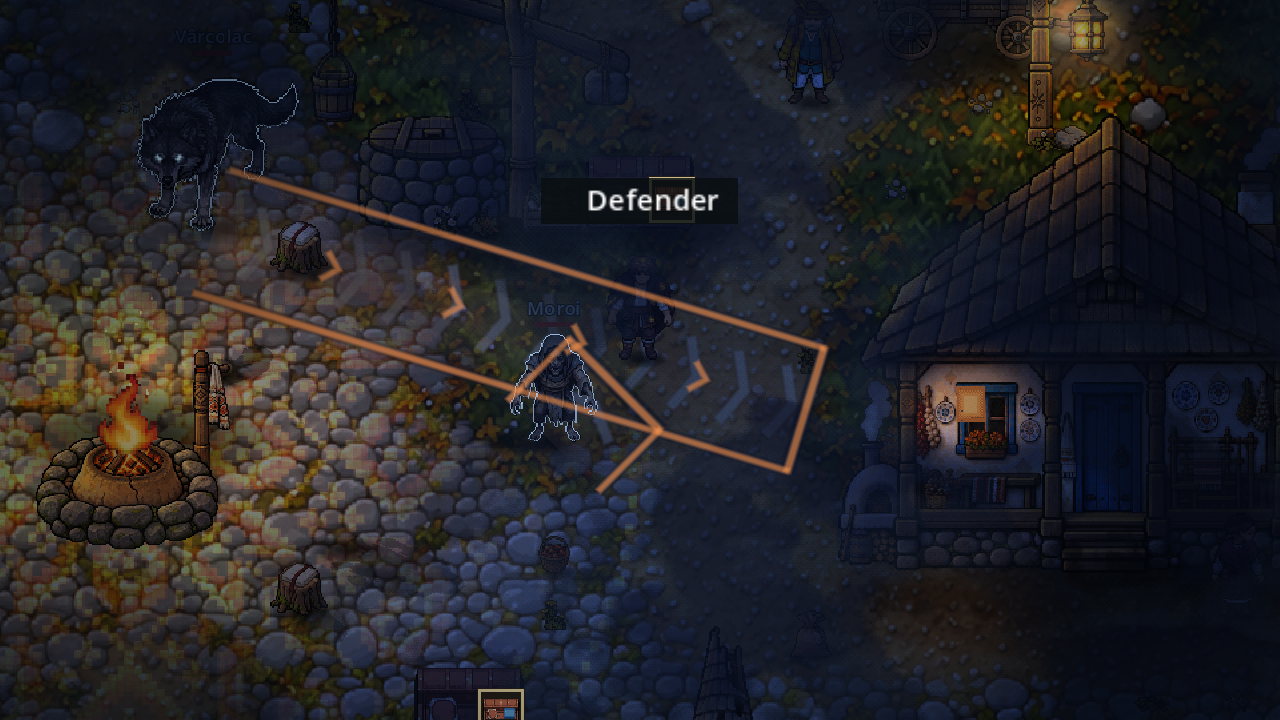
Offline combat rehearsal using current assets and staged warning states. Not a live multiplayer encounter or proof of final balance.
The warning has to tell the truth
A danger shape is a promise about space. Its full boundary should be readable before impact; timing can animate inside that boundary. A sword’s preview and its confirmed contact also need to agree. A brighter slash doesn’t fix a misleading reach indicator.
For a charge, the important questions are practical: where is it going, when does it commit, and can I get out? Once committed, its warning mustn’t quietly swivel after the player. A successful dodge should leave a real recovery opportunity, not merely postpone the next attack by an imperceptible amount.
The local candidate now checks collision-derived escape endpoints before committing certain profiled attacks, including overlapping warning shapes. That’s useful geometric evidence, not proof that a person has enough reaction time or stamina. Readability still has to survive darkness, scenery, allies and an actual player making mistakes.
Different monsters should ask different questions
We’re developing the existing roster, not adding another collection of abilities just to make the night busier.
- Strigoi provide ordinary close pressure. Light attacks need useful contact without cancelling every enemy action indefinitely; heavy attacks and well-timed defensive responses should create stronger openings.
- The vârcolac asks you to read a committed lane, step aside and use its recovery.
- The lantern-snuffer threatens the light. Recognizing it early should make interception and relighting possible.
- The moroi is being developed as a dark-ground stalker with a readable ambush and a solid attack/recovery window. Light helps, but a basic response must remain possible without a compulsory special weapon.
- The fire-eater cares about the hearth, not every player who hits it. Interrupting its drain should buy time to defend the coals.
- The strigoaică supports a marked group through an interruptible haste ritual in the revised profile. Reaching the source changes the surrounding fight; silver and heavy attacks help without becoming the only permitted answer.
These are roles and candidate behaviors, not a claim that every shipped content profile already uses them. Compatibility behavior remains for older content.
Valve’s Replayable Cooperative Game Design: Left 4 Dead is useful here because its special enemies address distinct cooperative problems. Our application is smaller and centred on a hearth: interception, sabotage, support and objective damage should demand different decisions.
Fairness belongs to the encounter, not just the creature
Two individually fair attacks can overlap into a situation with no useful response. We therefore need coordinated attack occupancy, stable targets, staggered commitment and sensible routes around the village’s actual walls and gates.
The candidate has bounded target leases and shared attack occupancy for revised profiles. Those rules are hypotheses about manageable pressure, not measured definitions of fun. A group also needs to arrive coherently instead of piling into a doorway or choosing a new victim every tick.
Fatshark’s Darktide enemy design and prototyping post is a helpful account of specialist roles, solo counterplay and giving players room after a successful response. We’re borrowing the questions, not its timings or difficulty numbers.
A breather must actually feel quiet
Stopping new spawns doesn’t produce relief if the previous group is still attacking. Valve’s Survival mode design notes discuss precisely that scheduling problem: unfinished threats overlap, and a lull isn’t the same as an empty battlefield.
For Vatra, authored encounters should introduce a demand, combine familiar demands, reach a climax and allow recovery. Preparation must visibly ease that same encounter. We don’t want the game to erase the value of a good wall by secretly compensating with extra pressure. The new authored profile separates this approach from legacy adaptive scheduling.
How we’ll judge the result
We’ll compare small, repeatable fights with fixed equipment and preparation before judging full nights. Can someone predict the hit? Explain a miss? Recognize the snuffer? Dodge the wolf and use the opening? See which defence bought time?
Rule tests and native rehearsal images can catch defects. They can’t establish enjoyment. The final test is a player making a decision, seeing why it worked, and wanting to defend the village again.
